
01
Roof tune-ups
Address selected maintenance items such as compatible sealant details, minor flashing concerns, debris at drains, and documented vulnerable areas.
Practical maintenance, repair, replacement, gutter, and sheet-metal scopes for commercial and multi-unit properties.
Commercial roofing decisions affect more than the roof surface. Access, tenant activity, equipment, drainage, penetrations, phasing, safety, and disruption all shape the plan. We document conditions and define a scope that property owners and managers can evaluate clearly.
The exact combination of work is confirmed after inspection and written into the proposal.
Address selected maintenance items such as compatible sealant details, minor flashing concerns, debris at drains, and documented vulnerable areas.
Investigate and repair localized membrane, flashing, penetration, edge, drainage, or sheet-metal issues within a defined scope.
Plan a compatible low-slope or steep-slope replacement around building use, equipment, drainage, access, and project phasing.
Coordinate gutters, scuppers, conductor heads, downspouts, coping, edge metal, counterflashing, and other custom transitions.
Plan single-ply membrane repair or replacement around seams, rooftop equipment, drainage, edges, and compatible accessories.
Evaluate and service multi-layer low-slope assemblies with careful attention to laps, flashings, penetrations, and heat exposure.
Prepare and coat eligible roof systems to reinforce weathering surfaces and reflective performance where the existing assembly is suitable.
Inspect and coordinate primary drainage, overflow paths, strainers, conductor heads, and the membrane transitions around them.
Create a practical inspection and maintenance schedule around roof type, equipment traffic, drainage, known repair areas, and property needs.
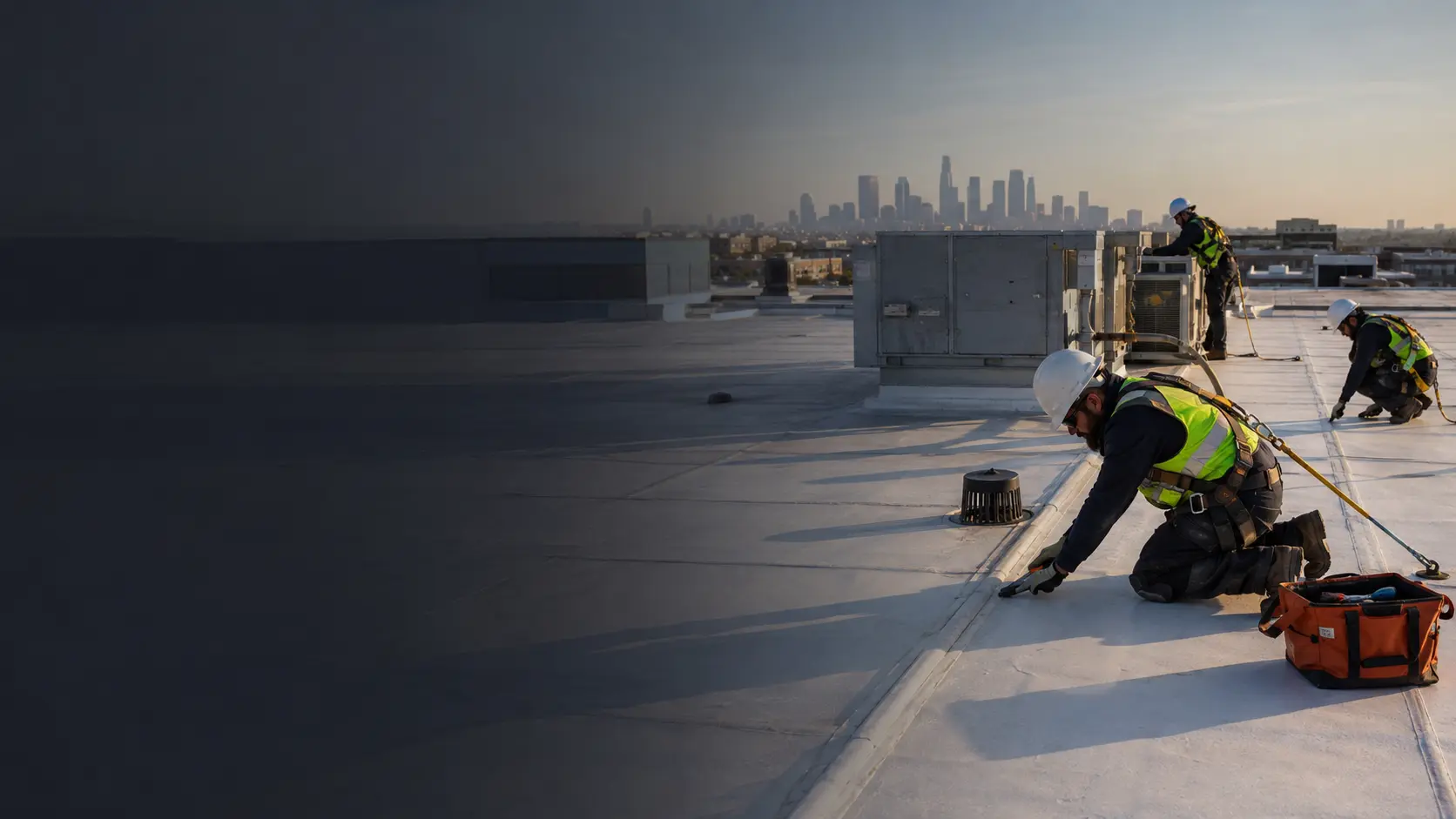
Condition photos and scope notes make it easier to communicate with owners, managers, tenants, and other project stakeholders.
Access, deliveries, noise, odors where relevant, occupied spaces, equipment, and work sequencing are considered early.
Observed drainage, penetrations, seams, flashings, and prior repair areas can be documented for future planning.
One symptom does not establish a diagnosis. It is a reason to document the concern and have the relevant roof areas evaluated.
Schedule an inspectionRecurring leaks near drains, penetrations, walls, or rooftop equipment
Open seams, blisters, cracks, punctures, or displaced roof materials
Ponding water that remains after typical drainage time
Corroded, loose, or separated edge metal and flashings
Interior staining or unexplained moisture in occupied spaces
An incomplete or outdated roof-maintenance record
Specific timing depends on access, roof conditions, materials, weather, approvals, and project size.
Access, contacts, occupied areas, roof equipment, known leaks, and operational constraints are reviewed.
Accessible roof surfaces, drainage, flashings, penetrations, edges, and representative problem areas are documented.
Repair, maintenance, or replacement options are organized into a clear proposal with practical sequencing.
Work is coordinated around the property, completed to the agreed scope, cleaned, and reviewed with supporting documentation.
These are general answers. A recommendation for your property requires inspection and a defined scope.
Often, yes. The feasibility depends on the roof system, condition, drainage, interfaces, leak risk, access, and how one phase connects to the next. Phasing should be planned before work begins.
A tune-up is a defined maintenance scope, not a substitute for needed replacement. Included items should be listed specifically after inspection because roof systems and conditions vary.
Send the property address, a short description, and safe-to-take photos if you have them. We’ll start with the appropriate next step.